


G80 Master Link
Single Master Link Grade 80 Grade 80 with flat section Straight WLL available from 1,600 Kg to...

G80 Master link 3 or 4 legs
EN 1677-4 compliant Grade 80 with flat section WLL from 3,150 kg to 26,500 kg Red lacquered...

G80 Connecting link
Connecting link for sling EN 1677 compliant Grade 80 WLL from 1,120 kg to 12,500 kg Red...

- -15%
G80 eye grab hook
Chain Shortening Hook, Grade 80 Standard EN 1677 with safety cerificate Grade 80 WLL available...

- -15%
G80 clevis grab hook
Standard EN 1677 with CE Grade 80 WLL available from 1,120 Kg to 8,000 Kg Red lacquered finish...

G100 Coupling Link
Connecting link for chain sling EN 1677 standard Grade 100 WLL from 1,400 kg to 10,000 kg...
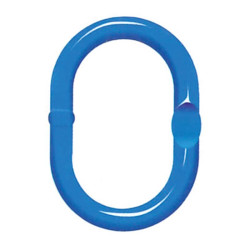
G100 Master Link
Grade 100 with flat section WLL available from 2,500 kg to 17,000 kg EN 1677 standard Painted...
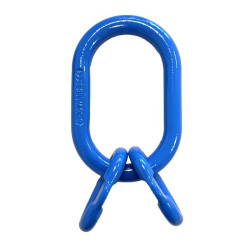
G100 triple master link
EN 1677-4 standard Grade 100 with flat section WLL available from 3,000 kg to 21,200 kg Painted...

- -15%
G100 clevis grab hook
Grade 100 chain shortening hook EN 1677 standard Grade 80 WLL available from 2,500 kg to 10,000...

- -15%
G100 eye grab hook
Grade 100 chain shortening hook EN 1677 standard Grade 100 WLL available from 2,500 kg to 10,000...
Master Links and Connecting Links for Chain Slings
Discover our range of master links and connecting links for lifting, designed for the assembly, manufacture and maintenance of chain slings. Available in Grade 80 and Grade 100, these high-strength lifting components are suitable for professional applications in industry, construction and material handling.
Our range includes single master links, triple master link assemblies, connecting links and shortening hooks. The correct component must be selected according to the Working Load Limit (WLL), chain diameter and grade, number of sling legs and the overall sling configuration.
How to Choose a Master Link for a Chain Sling
The master link forms the upper connection point of a chain sling and is used to connect the sling to the hook of a crane, hoist or other lifting device. Its dimensions and WLL must be suitable for the complete lifting assembly.
Single Master Link
A single master link is commonly used in chain sling assemblies. Depending on the sling configuration and the manufacturer's recommendations, it can be used with single-leg or multi-leg lifting slings.
When selecting a master link, check:
- the Working Load Limit (WLL);
- the chain diameter;
- the Grade 80 or Grade 100 specification;
- the number of sling legs;
- the dimensions of the lifting equipment hook.
Triple Master Link Assembly
A triple master link assembly consists of one main master link combined with two intermediate links. This configuration is particularly suitable for certain multi-leg chain slings, including three-leg and four-leg lifting slings.
The intermediate links help connect and articulate the different sling legs while providing a suitable connection to the main master link.
Connecting Links for Lifting Chains
A connecting link is used to join the different components of a chain sling, including the lifting chain, master link, lifting hook or other compatible lifting accessories.
Our range includes Grade 80 and Grade 100 connecting links for high-strength lifting chains. Always check the chain diameter, grade and WLL to ensure that all components in the sling assembly are compatible.
What Is the Difference Between Grade 80 and Grade 100?
Grade 80 and Grade 100 refer to different strength classes used for lifting chains and lifting accessories. For a comparable chain diameter, a Grade 100 component may provide a higher Working Load Limit than a Grade 80 component, depending on the manufacturer's specifications.
When selecting a master link or connecting link, always check:
- the manufacturer's Working Load Limit;
- the chain diameter;
- the grade of the chain and components;
- the number of sling legs;
- the sling angles;
- the dimensional compatibility of all components.
Important: simply replacing a Grade 80 component with a Grade 100 component does not automatically increase the WLL of the complete chain sling. The capacity of the sling depends on all of its components and its configuration.
Shortening Hooks for Chain Slings
A shortening hook is used to adjust the effective length of a chain sling leg. This makes it possible to adapt the sling configuration to the load being handled.
Shortening hooks are available in different designs, including eye and clevis versions, and in Grade 80 or Grade 100. The shortening device must always be compatible with the diameter and grade of the lifting chain.
Components for Chain Sling Assemblies
A chain sling can be assembled from several components, including a master link, connecting links, lifting chain, lifting hooks, shortening hooks and an identification tag.
For complete sling assemblies, you can also browse our range of chain slings and lifting chains.
Accel Belgium supplies professional lifting accessories for industry, construction and material handling. If you require a specific sling configuration, WLL or assistance with component compatibility, our team can help you select the appropriate solution.
FAQ – Master Links and Connecting Links for Lifting
What is the difference between a master link and a connecting link?
A master link is normally positioned at the top of a chain sling and provides the connection to the hook of the lifting equipment. A connecting link is used to join individual sling components such as the chain, lifting hook and master link.
How do I choose the WLL of a master link?
The Working Load Limit must be suitable for the load and the complete sling configuration. The number of legs, sling angles, chain diameter and the capacity of all other components must also be taken into account.
Can a Grade 100 connecting link be used with a Grade 80 chain?
Components of different grades should not be combined without checking their compatibility and the manufacturer's instructions. The WLL of the complete assembly must always be based on the limitations of all components and the sling configuration.
Which standards apply to master links and chain sling components?
Depending on their design and function, chain sling components may be covered by different parts of the EN 1677 series. Chains used in lifting slings are notably covered by the EN 818 series. Always check the specific standard and conformity information supplied with each component.
Can a standard quick link be used for lifting?
A general-purpose quick link must not be used for lifting unless it has been specifically designed, rated and identified for lifting operations. Always use components with a clearly stated WLL and intended for lifting applications.
What is a triple master link used for?
A triple master link assembly is mainly used for certain multi-leg chain sling configurations. It consists of a main master link and two intermediate links, allowing several chain legs to be connected and articulated correctly.